The test
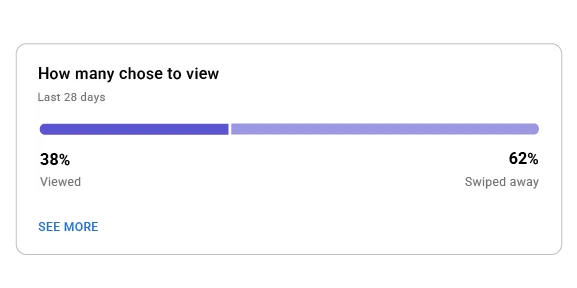
YouTube's help article on Content tab analytics defines, for Shorts specifically, "Shown in feed" as the number of times a Short showed in the Shorts Feed, alongside a separate figure it calls how many chose to view, describing the share of people who watched rather than swiped past. This record examines what the two figures are each said to measure and what conclusion YouTube's own documentation says a creator should not draw from a raw view count alone.
What the evidence says
A second help page, "Search & discovery tips" in its Shorts-specific version, lists the percentage of viewers who chose to view, average view duration and average percentage viewed as the signals YouTube says inform Shorts recommendations, alongside likes and post-watch survey responses. It states directly that Shorts performance does not negatively impact long-form Video recommendations, treating the two formats as separately judged. Both pages advise against comparing one format's numbers to another's, stating that audience behavior is different across formats so success may look different, and against benchmarking a video against a viral hit. Both are YouTube's own living help documentation, not a study of what actually drives any single video's reach.
The sample and the variance
The metrics apply to a creator's own Shorts as reported inside YouTube Studio, not a cross-platform or industry benchmark, and the documentation gives no population-level figures for what a typical shown-in-feed count or chose-to-view rate looks like. Chose to view is a YouTube-defined behavioral measure, not an independently audited figure, and the pages do not state how the underlying swipe data is collected or whether it is sampled or complete.
What to try next
As an editorial approach beyond the sources, a creator reviewing Shorts performance could pair shown-in-feed with chose-to-view before drawing a conclusion, since a high shown-in-feed count with a low chose-to-view rate points to a title or opening-frame problem, while the reverse points to a distribution problem, a distinction the raw view count alone does not carry. Comparing only within the same content format, as the documentation itself recommends, avoids one of the specific comparison errors YouTube's own pages warn against.
- Is your shown-in-feed count high while chose-to-view is low, or the other way around, and what does that split suggest?
- Are you comparing this Short only to other Shorts, or to a long-form video with different audience behavior?
- Have you checked average percentage viewed alongside views before concluding a video worked?
YouTube's own documentation gives creators two distinct diagnostic numbers rather than one, and its explicit advice is to read them together and within format, not to treat a single view count as a verdict.
Sources & limits
- Content tab analytics tips ↗
Defines 'Shown in feed' and 'how many chose to view' as separate Shorts diagnostic metrics.
Source · Source publication date not stated · Archive retrieval: 2026-09-16 - Search & discovery tips ↗
Lists the Shorts ranking signals and states that Shorts performance does not negatively affect long-form recommendations.
Source · Source publication date not stated · Archive retrieval: 2026-09-16