The test
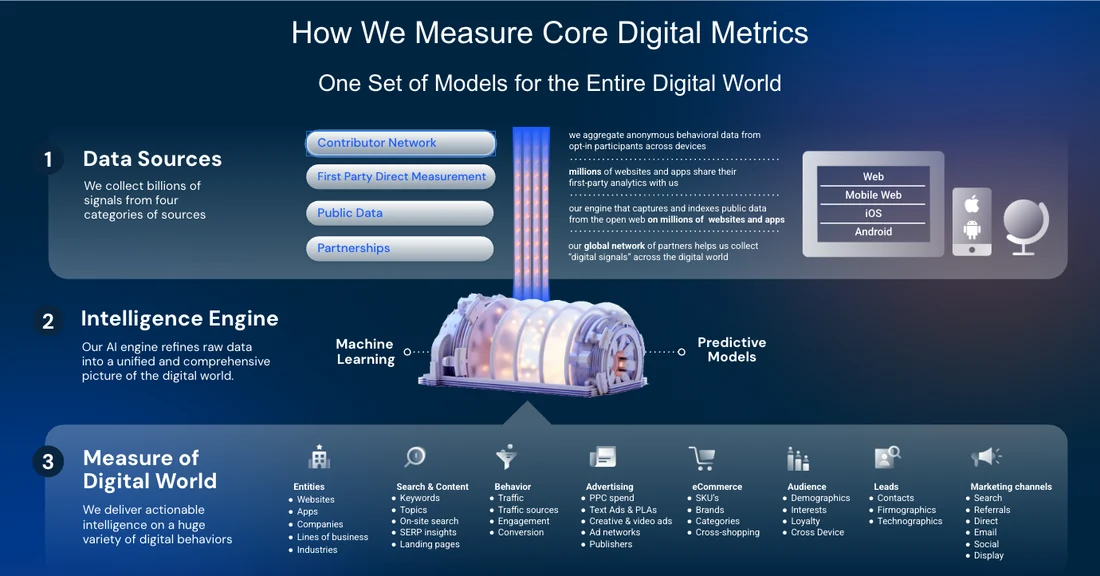
Similarweb is a commercial analytics vendor whose app-engagement and time-spent estimates are frequently cited for short-form video apps, and its own support documentation, retrieved 16 September 2026, sets out how those estimates are built. Similarweb's data methodology article describes what it calls an 'Intelligence Engine' with four stages — data collection, synthesis, modeling, and delivery — and states that the inputs come from four distinct source types rather than one measurement panel.
What the evidence says
Those four sources, as the article names them, are 'Direct Measurement' (first-party analytics that websites and apps choose to share), a 'Contributory Network' (anonymous device behavioral data from Similarweb's own consumer products), 'Partnerships' (data from internet operators, measurement companies and demand-side platforms), and 'Public Data Extraction' (an automated crawl of public web and app pages). The article states that after collection, data is 'cleaned,' 'classified' and run through machine-learning models that are 'trained,' 'refined for noise and bias reduction,' and 'blended' before being reported. This is a modeled estimate assembled from multiple inputs, not a single audience-metering panel of the kind an accredited panel like Ipsos iris describes, and the documentation does not publish a stated margin of error or confidence interval for its app-engagement figures.
The sample and the variance
Similarweb's mobile web FAQ narrows some definitions worth checking before citing a figure: it states that visits made on tablets 'count as mobile web,' and that a voice-assistant query, such as asking Siri to open a linked page, counts as a mobile web visit if it leads to a page load. Neither the methodology page nor this FAQ discloses sample sizes, panel counts, or coverage percentages for any specific app or country, which means a reader cannot verify how much of a given app's engagement estimate rests on directly measured data versus modeled extrapolation for that particular case.
What to try next
A reader citing a Similarweb figure for a short-form video app should describe it as a modeled, blended estimate rather than a measured panel result, and should note that Similarweb does not publish the confidence range or exact input mix behind any single number. This is an editorial recommendation: treat two Similarweb figures as comparable only when they come from the same reporting period and metric definition, since the underlying model can be recalibrated between releases without a public changelog in this documentation.
- Does the citation distinguish a Similarweb estimate from a platform-disclosed figure or a panel-based measurement such as Ipsos iris?
- Is there any stated confidence range, sample size, or coverage percentage attached to the specific figure being used?
- Were the two figures being compared drawn from the same Similarweb report vintage, given that its models can be recalibrated?
A vendor's description of its own modeling process is useful for knowing what a number is not: it is not a raw count and not a single-panel measurement, but a blended estimate whose precision Similarweb's public documentation does not quantify.
Sources & limits
- Similarweb Data Methodology ↗
States that Similarweb blends four categories of data (direct measurement, contributory network, partnerships, public data extraction) through machine-learning modeling rather than a single measured panel.
Source · Source publication date not stated · Archive retrieval: 2026-09-16 - Mobile Web Data FAQs ↗
States specific counting rules for Similarweb's mobile web classification, such as counting tablet visits as mobile web and counting a voice-assistant-triggered visit as mobile web.
Source · Source publication date not stated · Archive retrieval: 2026-09-16