The test
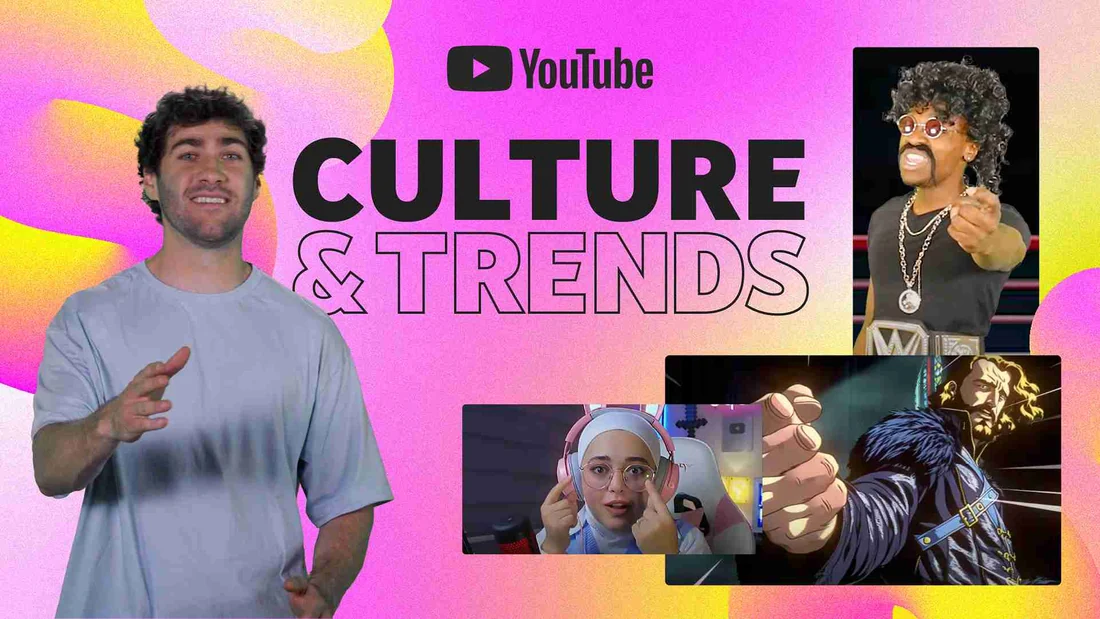
YouTube periodically publishes a Culture and Trends report that mixes its own platform analysis with a commissioned audience survey. The 2023 edition, published 22 June 2023 under the title 'Moving at the speed of culture,' states plainly how it was built: 'For our latest report, we conducted surveys in 14 countries and analyzed hundreds of trends to better understand how creative tools are being used.' The prior year's edition, published 22 June 2022, describes the identical two-part structure at smaller scale, stating that YouTube 'conducted surveys in more than 10 countries and analyzed hundreds of trends.'
What the evidence says
The two source types in each report carry different evidentiary weight, and YouTube keeps them visibly distinct in its own text. Survey-based claims are phrased as audience findings, such as the 2023 statement that '87% of people have watched at least 4 of the content formats that YouTube offers over the past 12 months,' or the 2022 statement that '65 percent of Gen Z agree that content that's personally relevant to them is more important than the content that lots of other people talk about.' Platform-data claims are phrased as YouTube's own counts, such as the 2023 statement that 'there have been more than 1.7 billion views of videos related to generative AI tools in 2023,' a figure attributed to YouTube's own viewing data rather than to survey respondents.
The sample and the variance
Neither report publishes the survey's sample size, exact fieldwork dates, or which countries were included beyond the aggregate percentages quoted; the surveys are described only as covering 'Gen Z' respondents in each stated number of markets. The platform-view figures, by contrast, come from YouTube's internal measurement of its own catalog and are not survey-derived, but YouTube does not disclose the underlying methodology for classifying a video as 'related to generative AI tools,' so that count should be read as YouTube's own categorization choice rather than an externally audited tally.
What to try next
A reader summarizing a Culture and Trends finding should state whether it came from the commissioned survey or from YouTube's internal trend analysis, since the two are combined in the same document but answer different questions. This is an editorial practice, not a YouTube instruction: treat the survey figures as attitudinal self-report from a stated but under-specified sample, and the platform figures as YouTube's own count under its own undisclosed classification rules.
- Does the specific statistic come from the commissioned multi-country survey or from YouTube's internal trend analysis of its own catalog?
- Does the report disclose the survey's sample size or fieldwork dates for the figure being cited, or only the aggregate percentage?
- Is a platform view-count figure, like the AI-content views tally, being extended past the year YouTube stated it for?
YouTube's own reports keep survey and platform data in the same document but not in the same sentence; a careful citation should do the same.
Sources & limits
- YouTube's Culture & Trends Report: Moving at the speed of culture ↗
States that the 2023 report combined an internal analysis of 'hundreds of trends' on YouTube with a commissioned survey run in 14 countries, and cites a platform view-count figure (1.7 billion views of generative-AI-related videos in 2023) separately from survey-based Gen Z percentages.
Source · Source date: 2023-06-22 · Archive retrieval: 2026-09-16 - YouTube's Culture & Trends Report: The Rise of Personally-Relevant Pop Culture ↗
States the prior year's edition used the same combined method, a commissioned survey in 'more than 10 countries' plus internal trend analysis, and defines the multi-format shift between short-form and long-form creators.
Source · Source date: 2022-06-22 · Archive retrieval: 2026-09-16