The test
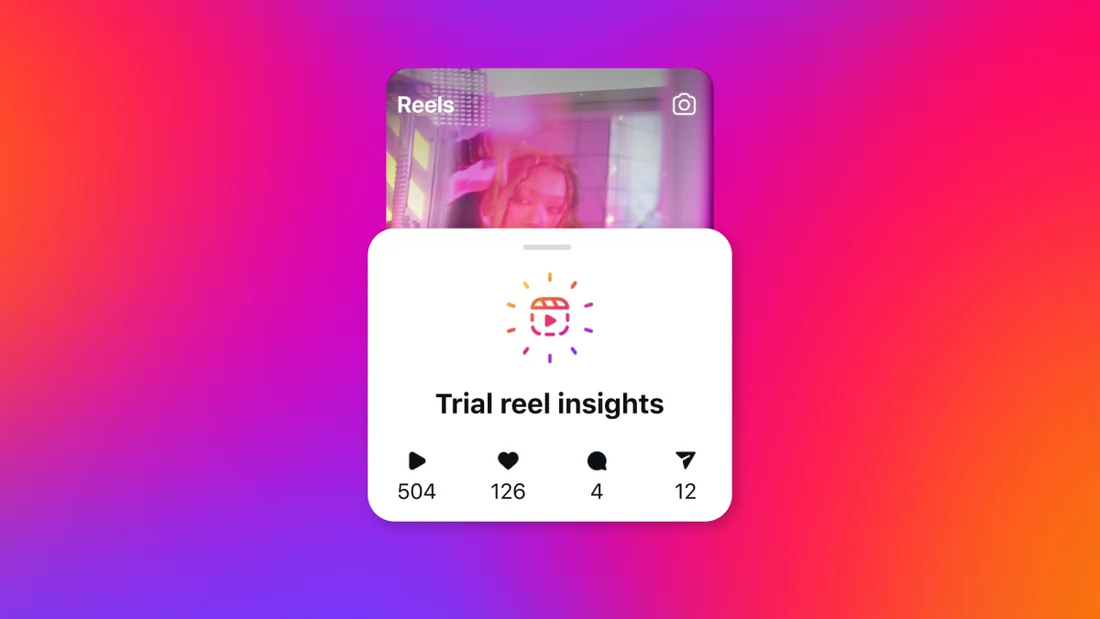
On 10 December 2024, Meta's newsroom announced Trial Reels, in a post titled "Test Content With Non-Followers Using Trial Reels," a setting that shows a new Reel to people who do not already follow the creator's account before it goes out more broadly. The post states that after roughly 24 hours, a creator can view how the trial performed, measured by views, likes, comments and shares, and can compare that trial against the creator's own past trials rather than against a fixed benchmark. The feature is aimed at letting a creator test a new format or topic without first putting it in front of an existing following.
What the evidence says
Meta's own account names three paths after a trial: a creator can manually select "share with everyone" to push the Reel to followers, turn on automatic sharing so a Reel that performs well within 72 hours goes out on its own, or leave the trial as is and never widen it. A companion page on Instagram's creator hub restates the same mechanism in shorter form, confirming the feature as Meta describes it rather than adding new detail. Meta's newsroom post also cites creator feedback that fresh content ideas performed well with both new and existing audiences; that is Meta's own summary of creator response, not an independently measured result, and it names no specific accounts, sample size or method.
The sample and the variance
Both documents describe a feature available to eligible Instagram creators generally, not a controlled test with a published cohort or comparison group. The 24-hour and 72-hour windows are Meta's stated mechanics, not measured medians, and "performs well" is Meta's own term with no published threshold behind it in either source. A trial's engagement numbers reflect exposure to non-followers specifically, which the sources describe as by design, so a trial result does not describe how the same Reel would perform if shown to existing followers first.
What to try next
As an editorial reading rather than a claim from Meta, a publisher could use a trial specifically to separate a format question from an audience question, since the tool's own design isolates non-follower response before any follower exposure happens. Comparing a trial only against that same account's prior trials, the comparison Meta's own interface offers, is likely to be more informative than comparing it to another creator's unrelated post.
- Is the trial's audience made up entirely of non-followers, as Meta's documentation describes, or has your account's mix changed?
- Are you comparing this trial to your own past trials, the comparison Meta provides, or to an unrelated benchmark?
- Would you have made the same share-or-hold decision without the 24-hour data point Meta's post describes?
Trial Reels is a distribution setting that Meta designed and describes in its own terms; the newsroom post and the creator hub page agree on how it works, but neither is an independent measurement of how much a trial changes an account's overall reach.
Sources & limits
- Test Content With Non-Followers Using Trial Reels ↗
Meta's own announcement of Trial Reels, its measurement window and the three post-trial sharing options.
Source · Source date: 2024-12-10 · Archive retrieval: 2026-09-16 - Create engaging content ↗
Instagram's creator-hub restatement confirming how Trial Reels works, without additional eligibility detail.
Source · Source publication date not stated · Archive retrieval: 2026-09-16